
Introduction
In today’s digital world, every business wants one clear answer: which marketing channel gives better ROI — email marketing or social media?
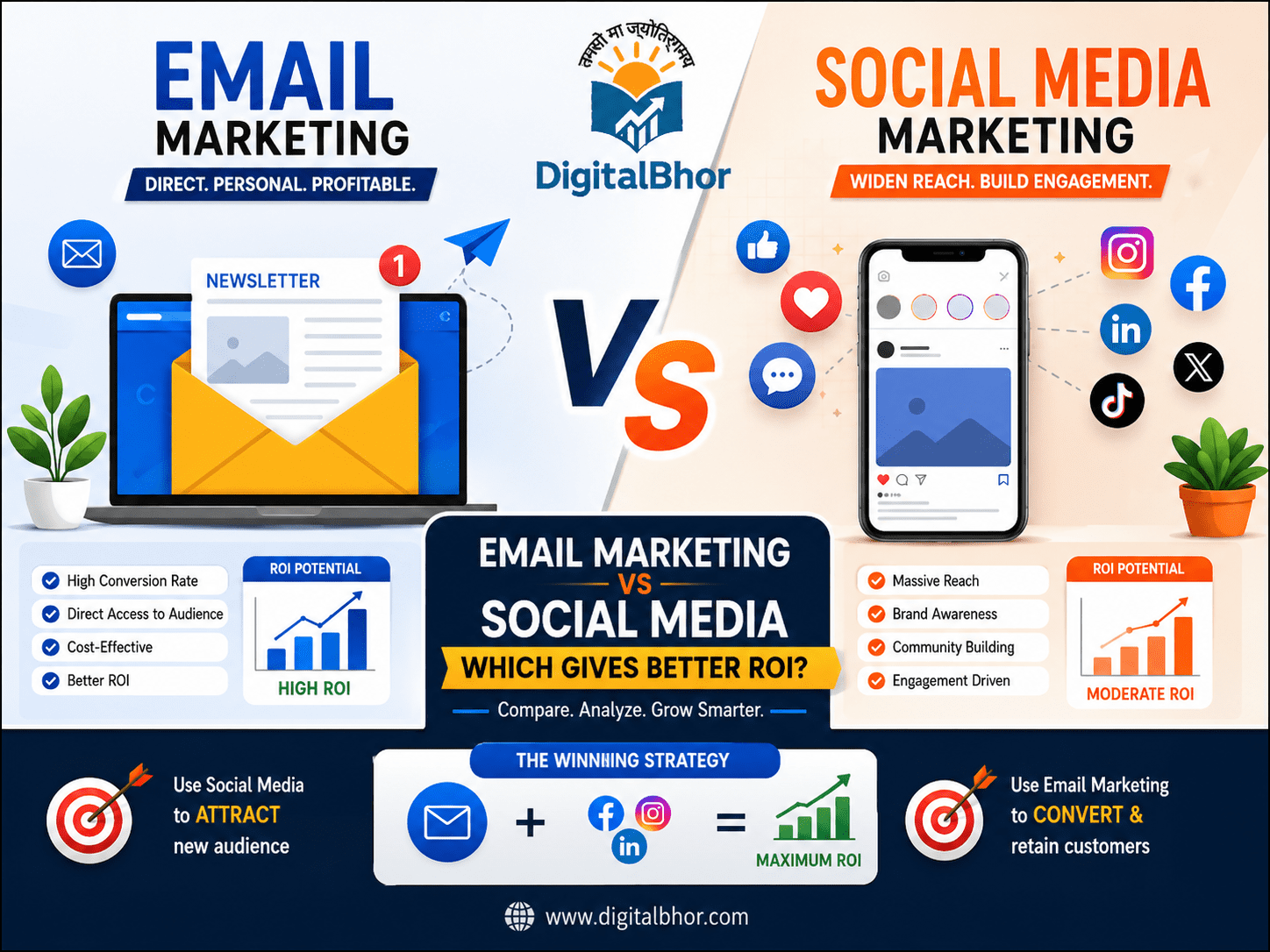
Both channels are powerful. Social media helps you reach new people, build brand awareness, and create engagement. Email marketing helps you build direct relationships, nurture leads, and convert customers into buyers.
But when we talk about Email Marketing vs Social Media ROI, the answer becomes more practical. ROI means return on investment. In simple words, how much money you earn compared to how much money, time, and effort you spend.
For small businesses, bloggers, creators, eCommerce brands, coaches, freelancers, and digital marketers, choosing the right channel matters a lot. If you spend your full energy only on social media, you may get likes and followers but not always sales. If you focus only on email marketing, you may get better conversions but miss new audience discovery.
So the smart strategy is not “email marketing or social media.” The smart strategy is understanding which channel works better for which goal.
In this complete guide, we will compare email marketing and social media based on ROI, cost, audience ownership, conversion, engagement, trust, automation, and long-term growth.
What is Email Marketing?
Email marketing is a digital marketing strategy where businesses send emails to subscribers, leads, and customers.
These emails can include:
- newsletters
- product offers
- discount coupons
- educational content
- abandoned cart reminders
- event announcements
- lead nurturing sequences
- customer follow-ups
The biggest advantage of email marketing is that you are communicating directly with people who already gave permission to hear from you.
This means your audience is warmer. They already know your brand, your product, or your content.
According to Litmus, email remains one of the strongest ROI channels, with many marketers reporting strong returns for every dollar spent on email campaigns.
What is Social Media Marketing?
Social media marketing means promoting your brand, product, content, or service on platforms like:
Social media is excellent for visibility. It helps people discover your brand even if they do not know you already.
Businesses use social media for:
- brand awareness
- community building
- product promotion
- customer engagement
- influencer marketing
- short-form videos
- paid advertising
- social proof
HubSpot’s marketing statistics show that platforms like Facebook and Instagram remain heavily used by marketers, with Facebook ranked by many marketers as one of the higher ROI-driving social platforms.
Email Marketing vs Social Media ROI: The Main Difference
The biggest difference is simple:
Email marketing is better for conversion and direct sales. Social media is better for discovery and brand awareness.
Email marketing reaches people who already showed interest. Social media reaches both warm and cold audiences.
That is why email usually gives better ROI when the goal is:
- sales
- repeat purchases
- lead nurturing
- customer retention
- course selling
- product launches
- affiliate marketing
Social media gives better results when the goal is:
- brand awareness
- audience growth
- community building
- viral reach
- influencer collaboration
- top-of-funnel visibility
So, if your question is strictly about ROI, email marketing usually performs better. But if your question is about reach and visibility, social media is very powerful.
Why Email Marketing Usually Gives Better ROI
1. You Own Your Email List
This is the biggest reason email marketing gives strong ROI.
On social media, you do not fully own your audience. Your Instagram followers, Facebook followers, or TikTok followers are controlled by the platform algorithm.
If the algorithm changes, your reach can drop overnight.
But with email marketing, your email list is your asset. You can directly reach your subscribers without depending completely on algorithmic visibility.
This makes email marketing more stable for long-term business growth.
2. Email Has Higher Buying Intent
People who join your email list are usually more serious than random social media viewers.
They may have:
- downloaded your free guide
- subscribed to your newsletter
- purchased something before
- registered for your webinar
- joined your waiting list
This means they already have some trust in your brand.
Because of this, email subscribers often convert better than general social media followers.
3. Email Automation Saves Time
Email marketing becomes even more powerful when you use automation.
For example:
- welcome email sequence
- abandoned cart email
- birthday offer
- post-purchase follow-up
- re-engagement campaign
- lead nurturing sequence
Once automation is set up, it works continuously.
Mailchimp explains that businesses should track ROI, automation, segmentation, and campaign performance to understand what is actually working in email marketing.
This means email automation can generate sales even when you are not manually sending messages every day.
4. Email is More Personal
Social media content is usually public and general.
Email feels more personal because it arrives directly in the inbox.
You can personalize emails using:
- customer name
- purchase history
- interests
- location
- behavior
- past engagement
Example:
“Hi Rahul, based on your interest in SEO, here is a free checklist.”
This personal touch increases trust and conversion.
5. Email Metrics Are Easier to Track
With email marketing, you can track:
- open rate
- click rate
- conversion rate
- unsubscribe rate
- revenue per email
- bounce rate
- list growth
- automation performance
Mailchimp’s benchmark data shows average open rates and click rates across industries, helping businesses compare their performance with broader standards.
This makes email marketing easier to measure compared to organic social media, where engagement does not always equal revenue.
Why Social Media Marketing Still Matters
Even though email marketing often wins in ROI, social media is still extremely important.
Here is why.
1. Social Media Builds Brand Awareness
People cannot buy from you if they do not know you exist.
Social media helps your brand reach new audiences through:
- reels
- shorts
- posts
- carousels
- stories
- live sessions
- collaborations
- hashtags
- paid ads
This is where social media is stronger than email.
Email works best after people enter your funnel. Social media brings people into that funnel.
2. Social Media Creates Trust Through Visibility
When people see your content regularly, they start recognizing your brand.
This builds:
- familiarity
- authority
- trust
- community
- social proof
For example, if someone sees your helpful Instagram reels daily, they may eventually join your email list or buy your product.
Social media creates the first touchpoint.
3. Social Media is Better for Viral Growth
Email cannot easily go viral.
But social media can.
One reel, one LinkedIn post, or one YouTube short can reach thousands or even millions of people.
This makes social media powerful for fast visibility.
However, viral reach does not always mean high ROI. Many viral posts get likes and views but do not generate sales.
That is why social media should be connected with email marketing.
4. Social Media Helps Community Building
Social media allows two-way conversation.
People can:
- comment
- share
- reply
- tag friends
- send DMs
- join lives
- participate in polls
This type of engagement helps build community.
Email is direct, but social media is more interactive.
Email Marketing vs Social Media: Cost Comparison
Email marketing costs usually include:
- email marketing software
- copywriting
- list building tools
- landing pages
- lead magnets
- automation setup
Social media costs usually include:
- content creation
- video editing
- graphic design
- paid ads
- influencer partnerships
- social media management tools
- content scheduling tools
Organic social media looks free, but it requires a lot of time and consistency.
Email marketing may need setup effort in the beginning, but once your funnel is ready, automation can produce long-term results.
For ROI, email often wins because the cost per conversion is usually lower after list building.
Email Marketing vs Social Media: Conversion Rate
Email generally converts better because the audience is warmer.
Social media audience may include:
- casual viewers
- followers who never buy
- people who only like content
- cold audience from explore pages
Email audience usually includes people who already showed intent.
That is why email is stronger for:
- selling digital products
- promoting services
- launching courses
- affiliate campaigns
- eCommerce offers
- repeat purchases
Social media is stronger for:
- attracting attention
- building audience
- educating people
- creating demand
Which is Better for Small Businesses?
For small businesses, the best answer is:
Use social media to attract people. Use email marketing to convert them.
Example strategy:
- Create Instagram reels or YouTube shorts.
- Offer a free checklist, guide, webinar, or discount.
- Collect email addresses.
- Send automated email sequence.
- Build trust.
- Promote your product or service.
- Retarget social media audience with ads.
This creates a complete digital marketing system.
For more practical guides on digital growth, SEO, AI tools, and marketing automation, you can explore Digital Bhor at https://digitalbhor.com/.
Which Channel Gives Better ROI?
If we compare only ROI, email marketing usually gives better ROI than social media.
Reason:
- lower cost per conversion
- direct audience access
- better personalization
- stronger buying intent
- easier automation
- better tracking
- higher repeat sales potential
But social media is still essential because it fills the top of the funnel.
A business that only uses email may struggle to grow its list. A business that only uses social media may struggle to convert followers into customers.
The winning formula is:
Social Media = Reach + Awareness
Email Marketing = Trust + Conversion + Sales
Together, they create a powerful marketing engine.
Best Strategy: Combine Email Marketing and Social Media
Instead of choosing one, combine both.
Here is a practical system:
Step 1: Create Valuable Social Media Content
Post content that solves real problems.
Examples:
- tips
- tutorials
- case studies
- before-after results
- mistakes to avoid
- mini guides
- behind-the-scenes content
Step 2: Add a Lead Magnet
Offer something valuable in exchange for email signup.
Examples:
- free PDF guide
- checklist
- discount code
- webinar
- free template
- mini-course
Step 3: Build an Email Sequence
Create automated emails such as:
- welcome email
- value email
- problem-solving email
- case study email
- offer email
- follow-up email
Step 4: Retarget with Social Media Ads
Use social media ads to retarget people who visited your website or joined your email list.
Step 5: Track ROI Properly
Track these metrics:
For email:
- revenue per campaign
- click rate
- conversion rate
- unsubscribe rate
- revenue per subscriber
For social media:
- reach
- engagement rate
- website clicks
- leads generated
- sales from social traffic
- cost per lead
- cost per purchase
When you track properly, you can see which channel gives better results for your business.
Final Verdict
So, Email Marketing vs Social Media ROI: which gives better ROI?
The clear answer is: email marketing usually gives better ROI.
But social media is better for reach, brand visibility, community, and discovery.
If your goal is fast awareness, use social media.
If your goal is consistent sales, use email marketing.
If your goal is long-term business growth, use both together.
The smartest businesses do not depend on one channel. They build an ecosystem where social media attracts attention and email marketing converts attention into revenue.
That is the real digital marketing growth strategy.